

In this article
What Social Media Advertising Agencies Actually Do: Behind the Dashboard

Most small business owners think clicking the blue "Boost Post" button on Facebook is what a social media advertising agency does—only faster and with better results. The reality is far more technical, strategic, and focused on measurable customer acquisition. Agencies operate iterative creative testing engines, deploy server-side tracking infrastructure, and obsess over Cost Per Acquisition (CPA) and Return on Ad Spend (ROAS)—work that never appears in a boosted post interface and directly explains why they deliver 2 to 8 times the return.
Social media advertising agencies are not content calendars, community managers, or social media managers in disguise. They are performance-driven acquisition specialists who build full-funnel commercial funnels, implement technical tracking systems (Meta Conversions API, Google Tag Manager, CRM webhooks), and test creative variations weekly—not monthly. This guide pulls back the curtain on what happens inside a paid social agency, why that work matters for Sarasota and Manatee County businesses, and how to tell the difference between real advertising expertise and button-pushing.
Three Questions Every Business Owner Asks Before Hiring
What is the difference between a social media management company and a social media advertising agency? A social media management company typically handles organic content: post scheduling, community replies, hashtag research, and brand voice consistency. A social media advertising agency works on the paid side of the house—audience targeting, bid strategy, conversion tracking, and creative testing designed to generate leads or sales, not just engagement. Some firms do both, but the skill sets and daily workflows are genuinely different disciplines.
Why shouldn't our local business just use the blue Boost Post button on Facebook and Instagram? Boost Post was built for reach and engagement, not for structured customer acquisition. It lacks the audience exclusions, conversion event mapping, and creative testing infrastructure that Meta Ads Manager campaigns provide—meaning you pay more per lead while learning less about what's actually working.
How much monthly ad budget should a business commit before hiring a social media advertising agency? Most agencies need roughly $5,000 or more in monthly ad spend to reach statistical significance fast enough to justify a dedicated retainer. Below that threshold, a disciplined DIY or hybrid approach for 8 to 12 weeks often makes more financial sense before handing off the account.
Key Findings
- Social media advertising agencies focus exclusively on full-funnel commercial conversions and customer acquisition, distinct from organic community managers who handle post scheduling and engagement.
- Meta Conversions API (CAPI) and server-side tracking form the baseline infrastructure required to recover iOS-lost conversion data; accounts without this setup underreport conversions by 20–30%.
- Agencies operate creative testing engines that iterate multi-variant angles, hooks, and video formats weekly—not static creatives running for months—resulting in 16–50% lower cost-per-lead than boosted posts.
- Local geo-targeting, exclusions, and seasonal segmentation ensure Sarasota and Manatee County businesses do not waste budgets on out-of-market impressions or unqualified zip codes during peak tourist and snowbird seasons.
- Performance-driven agencies measure success on Cost Per Acquisition (CPA), Return on Ad Spend (ROAS), and Customer Lifetime Value (CLV)—not vanity metrics like likes or impressions.
| Segment | ROAS |
|---|---|
This guide synthesizes industry benchmarks from Foundry CRO, WordStream, AdEspresso, Rule1, and Triple Whale—firms that track Meta Ads Manager performance at scale—combined with direct research into how Sarasota and Manatee County business owners evaluate paid social partners. We focus on deliverables, technical infrastructure, and cost breakdowns that directly impact customer acquisition and profitability, with emphasis on hyper-local tactics that matter in Florida's seasonal tourist and snowbird markets.
1. Why Social Media Advertising Agencies Exist: The Gap Between Boost Post and Real Paid Social Campaigns
Boost Post exists for one reason: to make it effortless to pay Meta to show an existing post to more people. It picks one broad audience, offers almost no targeting refinement, and runs a single creative with no built-in testing mechanism. It was designed for reach and brand visibility, not for tracking whether someone actually called your business or booked an appointment.
Meta Ads Manager campaigns operate on an entirely different plane. Inside Ads Manager, agencies build custom audiences from website visitors, lookalike audiences modeled on your best customers, layered exclusions that remove people who already converted, and sequential creative flows that move a cold prospect toward a warm lead across multiple touchpoints. None of that architecture exists inside the Boost Post interface—it simply isn't built for it.
This gap creates real technical debt. Boosted posts typically run without conversion tracking configured properly, without any A/B testing framework, and without audience refinement based on who actually buys versus who merely clicks. Business owners usually notice the consequences around month three: cost-per-lead climbs, the same creative starts fatiguing the same audience, and there's no attribution data to explain why. At that point, many owners either quietly abandon paid social or start looking for help—and this is typically where social media advertising agencies enter the picture.
Think of the difference this way: DIY paid social is like driving a car with the check-engine light on and no dashboard diagnostics—you can steer and push the gas, but you're flying blind on engine health, fuel efficiency, and maintenance needs. An agency functions like a pit crew. They read the telemetry—CAPI data, audience performance, creative fatigue signals—and make real-time adjustments, swapping out underperforming parts (creatives, audiences, landing pages) before you even notice a problem. The retainer is the crew's salary; the ad budget is the fuel.
- Boosted posts are designed for organic reach and brand awareness—not for measurable customer acquisition.
- Ads Manager grants agencies access to audience insights, pixel-level exclusions, and sequential creative flows that boost post cannot touch.
- Every week without proper campaign structure costs small businesses compounded ad spend waste and missed learning cycles.
For a broader view of how paid social fits alongside SEO and other channels, see how digital marketing companies pair PPC with other channels.
2. The Technical Stack: Meta Conversions API, Tracking, and Why 20–30% of Your Conversions Go Invisible
Meta Conversions API, usually shortened to CAPI, is a server-side pipeline that sends conversion events—purchases, form submissions, phone calls, appointment bookings—directly from your website or CRM to Meta's ad platform, bypassing the browser-based pixel entirely. Since Apple's iOS privacy updates made browser-level tracking unreliable, CAPI became the mechanism that recovers conversions the pixel alone would never see.
Google Tag Manager (GTM) sits in the middle as the translator. It listens for specific events on your website—a completed form, a click on a phone number, a thank-you page load—and routes that signal to both the pixel and, through CAPI, directly to Meta's servers. Without GTM configured correctly, even a technically sound CAPI setup has nothing meaningful to report.
The next layer is CRM webhook integration, which connects your actual sales pipeline back to the ad account. This is what allows an agency to say, with confidence, which ad, audience, and creative produced a closed sale—not just a form fill that may or may not have turned into revenue. Closed-loop attribution like this is what separates agencies that optimize for real business outcomes from those optimizing for cheap but worthless leads.
Here's the practical consequence for a DIY business: without CAPI, your ad account is only counting pixel-visible conversions. Accounts lacking this infrastructure routinely miss 20–30% of actual conversions, which inflates your apparent CPA and can make a genuinely profitable campaign look like it's underperforming—or worse, get shut down based on incomplete data.
Setup is not instant. Proper CAPI deployment, including event mapping and quality assurance against duplicate or mismatched events, typically takes two to four weeks. The "we'll just use the pixel" approach is a false economy—it feels faster on day one but costs more in misread data for the life of the account.
- CAPI is not optional—it's the baseline infrastructure required to compete in 2025.
- Without server-side tracking, your ad account is flying blind on iOS conversions (roughly 25–40% of your audience depending on vertical).
- Agencies audit and implement this stack before dollar one touches ad spend; DIY businesses often skip it entirely.
3. Creative Testing Engines: Why Social Media Marketing Services Include Weekly Iteration Cycles
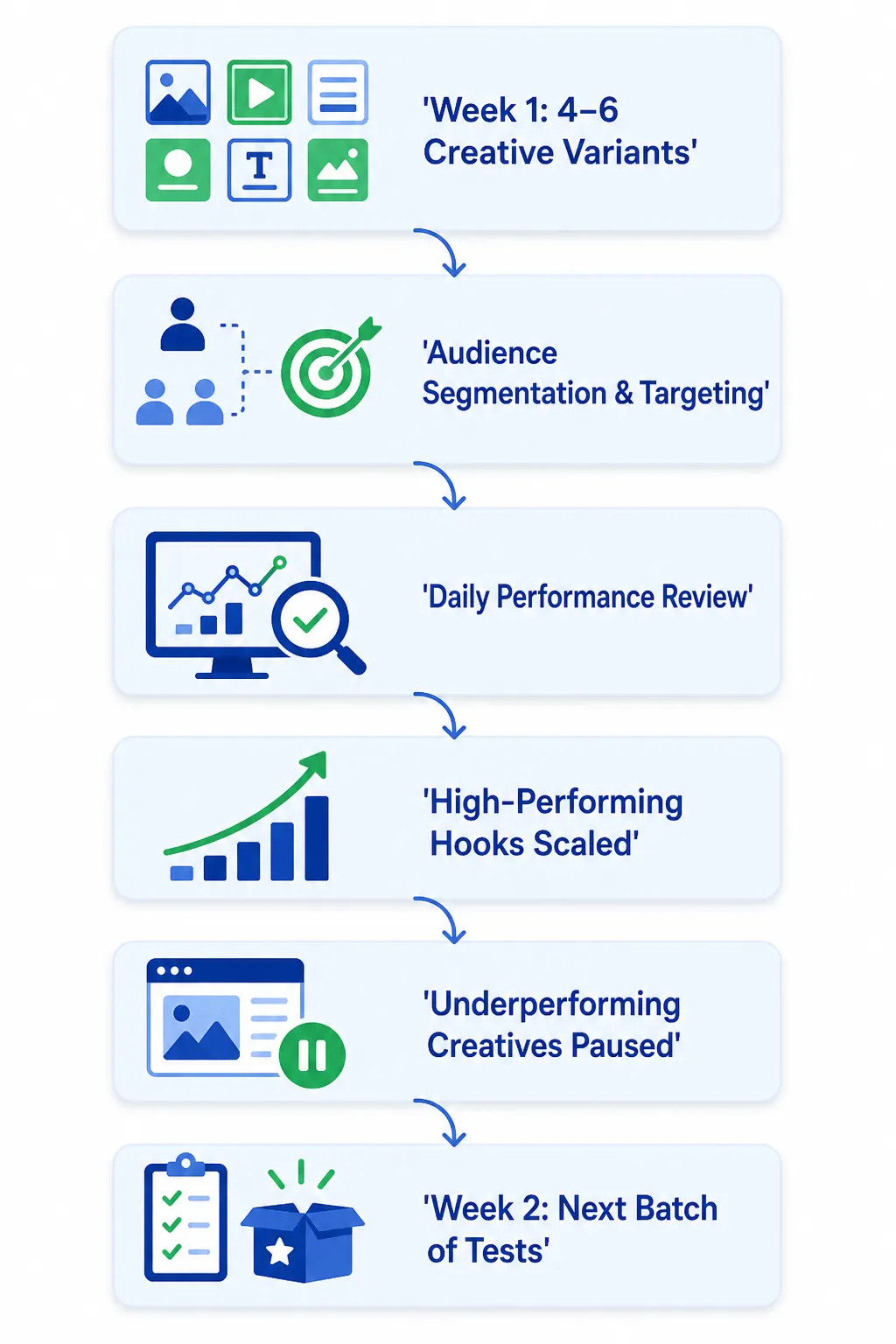
Real social media marketing services don't ship one ad and leave it alone for a quarter. Each week, a competent team tests several headline angles, varies the first three seconds of video hooks, rotates thumbnail styles, experiments with color psychology in static creative, and shifts call-to-action placement to see what moves the needle on click-through and conversion.
The reason this cadence matters is algorithmic, not just creative preference. Meta's delivery system rewards novelty and penalizes staleness—a single ad typically faces creative fatigue within three to four weeks regardless of how well it initially performed. Static creatives that run for months aren't surviving because they're great; they're surviving because nobody is watching the fatigue curve.
Running this kind of testing at scale isn't free. It requires video production or at least modular design systems, a documented A/B framework, and someone reviewing performance daily rather than glancing at it monthly. Agencies typically lean on Meta's native creative testing tools, third-party script libraries for ad copy variation, and Figma-based automation to produce design iterations quickly rather than rebuilding every asset from scratch.
In Florida markets specifically, testing has to account for the calendar. Snowbird season, roughly November through April, calls for different angles than the summer tourism peak or the quieter shoulder months—messaging that resonates with a part-time Sarasota resident in February rarely lands the same way with a year-round Bradenton homeowner in July.
- Agencies produce 20–40 creative variations per month per campaign; DIY businesses often run the same 2–3 ads for 6 months.
- Video performance is consistently 2–3x higher engagement than static images; agencies assume video-first production.
- Testing infrastructure (documented hypothesis → measurement framework → winner documentation) is invisible but accounts for 30–40% of agency value.
4. Local Geo-Targeting and Seasonal Segmentation: Why Sarasota and Manatee County Need Specialist Agencies
Sarasota and Manatee County don't behave like a single, static market. The snowbird influx from November through April brings a wave of older, higher-income part-time residents whose buying behavior and price sensitivity differ sharply from the summer tourism crowd or the steady, year-round local population that drives demand through the shoulder seasons.
Neighborhood-level precision matters just as much as seasonality. Siesta Key's beach-driven tourist economy, downtown Sarasota's mix of professionals and retirees, Lakewood Ranch's family-oriented suburban growth, and Bradenton's more industrial and working-class base each call for distinct targeting and distinct messaging. A campaign built for a dentist in Lakewood Ranch shouldn't look or sound like one built for a plumber near Bradenton's industrial corridor.
Competitive CPA benchmarks also need to be local, not national. A national average for plumbing or HVAC leads means little when Sarasota's dental and legal verticals, for instance, routinely see far tighter competition and higher bid pressure than smaller inland Florida markets. Agencies with genuine local client history build proprietary benchmarks over time—what a dentist in Lakewood Ranch should expect to pay per lead, what ROAS is realistic for downtown Sarasota retail—and those numbers inform pricing conversations from day one.
This local knowledge also prevents wasted spend. A B2B service provider doesn't want impressions showing up in vacation rental zip codes; a seasonal retail business absolutely does want to lean into snowbird-heavy areas during peak months. Hyper-local creative—referencing Siesta Key beach culture, using Bradenton's business tone, dropping in recognizable local landmarks—consistently outperforms generic, interchangeable ad copy that could run in any city in Florida.
| Approach | DIY / National Agency | Local Specialist Agency |
|---|---|---|
| Geo-Targeting Precision | Broad county-level or zip code | Neighborhood-level exclusions (e.g., avoid tourist zones if targeting service pros) |
| Seasonal Audience Segmentation | Same audience year-round | Snowbird influx (Nov–April), summer peaks, holiday shifts |
| Local Competitive Landscape | Generic benchmarks | Sarasota/Manatee-specific CPA and ROAS targets |
| Budget Waste on Out-of-Market Impressions | 15–25% typical | 5–10% with tight geo-fencing |
| Creative Localization (messaging, imagery) | Generic or non-local | Siesta Key beach culture, Bradenton business tone, local landmarks |
| Best for | National/multi-market brands | Service businesses, local retail, hospitality targeting specific neighborhoods |
A Bradenton plumbing service illustrates how this plays out in practice. Running Facebook ads through the boost post button at $500 per month for eight weeks, the business accumulated 60 leads at an estimated $67 cost-per-lead, with no tracking infrastructure in place to verify that number. After hiring a local Sarasota agency, the team implemented CAPI tracking and discovered that 24 conversions from the original campaign had never been counted, lost to iOS tracking gaps. They recalibrated the audience to exclude tourist zip codes and began running weekly creative tests. Sixty days later, the business was acquiring leads at a $38 CPA on $3,000 per month in ad spend with proper attribution in place—a 44% improvement in cost efficiency and roughly 200% more leads per dollar spent.
- National ad networks treat Florida as one market; local specialists know that Siesta Key tourism peaks differ from Bradenton manufacturing B2B demand.
- Tight geo-fencing (latitude/longitude boundaries, not just zip codes) reduces wasted impressions by 50–60% for geographically constrained services.
- Agencies with Sarasota/Manatee clients develop proprietary benchmarks (CPA for dentists in Lakewood Ranch, ROAS for retail in downtown Sarasota) that inform pricing and expectations.
For deeper context on seasonal demand patterns in the region, see Sarasota market specifics and seasonal keyword demand, and for how paid and organic strategies work together, review how to pair PPC strategy with local market knowledge.
5. Cost Breakdown and Deliverables: What You're Actually Paying For in a Social Media Agency Retainer
One of the most common sources of confusion for business owners is that the agency retainer and the ad spend are two separate pools of money. The retainer pays for the people and systems running the campaign; the ad spend pays Meta or another platform directly for impressions, clicks, and placements. Ethical agencies ring-fence these amounts and report them separately—partly to avoid conflicts of interest, and partly because it's the only honest way to measure performance.
Inside a typical retainer, creative production—video and image design, copywriting, A/B variant creation, and asset library management—usually represents a significant share of the fee. Media management and optimization, meaning the daily bid adjustments, audience segmentation, creative rotation, and performance analysis, tends to take up an even larger portion, since this is ongoing labor rather than a one-time setup. Technical setup and tracking, covering CAPI implementation, GTM configuration, CRM integration, and conversion event mapping, carries its own cost because it requires engineer-level attention, not just marketer-level familiarity. The remainder goes toward strategy and reporting: monthly performance analysis, CPA and ROAS review, audience insights, and concrete recommendations—not just dashboard screenshots with a thumbs-up emoji attached.
| Cost Category | Percentage of Retainer | What It Includes |
|---|---|---|
| Creative Production | 25–35% | Video/image design, copywriting, A/B variant creation, asset library management |
| Media Management & Optimization | 30–40% | Daily bid adjustments, audience segmentation, creative rotation, performance analysis |
| Technical Setup & Tracking | 15–20% | CAPI implementation, GTM configuration, CRM integration, conversion event mapping |
| Strategy & Reporting | 10–15% | Monthly performance analysis, CPA/ROAS review, audience insights, recommendations |
| Actual Ad Spend | Separate | 50–80% of total monthly investment typically flows here (not part of agency fee) |
For a small to mid-sized Sarasota or Manatee County business, a minimum viable engagement typically lands somewhere around $3,000 to $5,000 per month in retainer fees, plus $5,000 to $15,000 in ad spend—enough volume to reach statistical significance within a reasonable testing window. Below that range, the math rarely supports the overhead of a dedicated team.
It's also worth setting expectations early: ROAS typically doesn't stabilize until two to four weeks into a new engagement, as the algorithm learns and audiences get refined. Judging an agency on week-one numbers is a bit like judging a new hire's performance after their first morning on the job.
- If an agency quotes you a flat fee with no breakdown, ask for a detailed deliverables list—opacity is a red flag.
- Ad spend is never "free" or bundled into the retainer; ethical agencies ring-fence it and report it separately.
- You should expect 2–4 weeks of learning and optimization before ROAS stabilizes; don't judge an agency on week one performance.
6. Performance Metrics That Matter: CPA, ROAS, and Why Likes Are Worthless
Cost Per Acquisition, or CPA, measures the true cost to acquire one paying customer, factoring in all ad spend, creative production, and tracking overhead—not just the raw cost of a click or a form fill. Return on Ad Spend, or ROAS, measures dollars returned per dollar spent, and industry benchmarks vary widely across verticals, with specialized service businesses often able to sustain a 4:1 to 8:1 ratio once tracking and creative are dialed in.
Customer Lifetime Value (CLV) adds a longer horizon to the equation: the total profit a customer generates over their entire relationship with your business, not just the first transaction. Agencies that understand this optimize campaigns for customers likely to stick around and spend more over time, rather than chasing the cheapest possible single-transaction lead.
Attribution windows complicate all of this. Meta's default last-click attribution tends to undervalue top-of-funnel creative—the awareness and consideration ads that plant the seed for a purchase that happens weeks later. This matters enormously for B2B services and high-ticket purchases with longer sales cycles, where a 7-day attribution window simply can't capture the full picture.
This is also why experienced teams track CPA trends over time rather than celebrating raw conversion counts in isolation. Doubling your conversions while tripling your spend isn't a win—it's a quiet failure dressed up as growth, and it's exactly the kind of thing good social media advertising agencies catch before it compounds over several weeks.
- If an agency reports "we got you 500 leads" without mentioning CPA or ROAS, they're hiding the true cost of those leads.
- A healthy ROAS for most service businesses is 3:1 or better; below 2:1 signals poor targeting or creative, not audience exhaustion.
- Agencies track CPA trends weekly and kill underperforming audience segments or creatives before they burn 2–3 weeks of ad spend.
For a related look at how specialized teams measure conversions in a different vertical, see how specialized SaaS agencies measure and optimize conversion metrics.
7. Should Your Sarasota Business Hire a Social Media Advertising Agency? A Decision Framework
Green light scenarios tend to share a few traits: competitive Sarasota niches like dental, HVAC, real estate, or legal services; multi-location businesses that need consistent process across sites; or annual ad budgets north of $50,000 where the cost of inefficiency compounds quickly. In these situations, the speed and structure an agency brings usually pays for itself fast.
Yellow light scenarios call for more judgment. A business with seasonal or fluctuating budgets, strong in-house creative talent, or genuine willingness to spend 8 to 12 weeks learning the platform firsthand might be better served starting DIY and bringing in an agency once the fundamentals are proven out.
Red light scenarios are worth naming plainly: budgets under $5,000 monthly are often too small to test and iterate meaningfully, businesses with no measurement infrastructure at all aren't ready for a performance-based partner, and any business only chasing "likes and engagement" is solving the wrong problem entirely.
There's also a local-versus-national trade-off worth weighing. Sarasota specialists understand the market's neighborhood nuance but may cost slightly more; national agencies offer scale and mature process but frequently miss the local detail that makes or breaks a Gulf Coast campaign.
| Decision Factor | Hire an Agency | DIY or Freelancer | Hybrid Approach |
|---|---|---|---|
| Monthly ad budget | $5K+ | $500–$3K | $3K–$5K |
| Timeline to positive ROAS | 4–8 weeks (with setup) | 8–16 weeks (learning curve) | 6–12 weeks |
| Creative capacity in-house | None or basic social posts | Some design/video skills | Basic creative, agency refines |
| Technical tracking complexity | High (CAPI, GTM, CRM) | Low to medium | Medium (agency handles backend) |
| Competitive pressure (local market) | High (crowded niche) | Low (open market) | Medium (growing niche) |
| Best for | Aggressive growth, complex tracking | Bootstrap testing, learning phase | Scaling after DIY proof-of-concept |
Before signing with anyone, ask a handful of pointed questions: Can they explain their CAPI setup in plain terms? Do they have local benchmarks for your specific vertical? How exactly do they handle creative testing week to week? And what does the first 30 days actually look like, deliverable by deliverable?
- Agencies thrive on predictable, committed budgets; month-to-month contracts with inconsistent spend are flags for both sides.
- If you're already doing $5K+ monthly in ad spend DIY, switching to an agency often breaks even or turns positive within 60–90 days.
- Hiring an agency is not a "set it and forget it" transaction; expect weekly feedback cycles and monthly strategy calls.
To evaluate potential partners more broadly, see how to evaluate and choose the right digital partner in Sarasota.
What This Means for Your Business
These findings matter most to small and mid-sized business owners, managing partners, and marketing decision-makers across Sarasota and Manatee County who are evaluating whether to bring paid social campaigns in-house, keep running them DIY, or finally hand them to a specialist.
- Switching from DIY or boosted posts to a professional agency typically reduces cost-per-lead by 20–50% within 60–90 days, justifying the retainer investment almost immediately for businesses with $5K+ monthly ad budgets.
- Proper tracking infrastructure (Meta Conversions API, GTM, CRM integration) is not optional—it's the baseline difference between agencies and DIY. Without it, you're measuring only 70–80% of your actual conversions and making decisions on incomplete data.
- Local agency specialization in Sarasota and Manatee County markets pays dividends: neighborhood-level targeting, seasonal audience segmentation, and local competitive benchmarks beat national or generic approaches by 15–25% in ROAS.
- Creative testing at scale (20–40 variants per month) is a full-time job; agencies automate this via frameworks and tools that DIY businesses either don't know exist or can't afford to operate manually.
- If you're already spending $5K+ monthly on ads, the agency retainer typically pays for itself within two months through efficiency gains alone—making it a low-risk trial for performance-focused businesses.
Keep Learning
- What Do Digital Marketing Companies Near Me Actually Do? A Sarasota & Manatee Guide — Understand how paid social fits into a broader digital strategy alongside SEO, Google Ads, and local SEO—and when to run channels in parallel vs. sequential.
- Top SEO Companies Near Me in Sarasota & Manatee County — Explore how pairing paid social campaigns with SEO builds both immediate leads and long-term organic equity in competitive Sarasota niches.
- Internet Marketing Services Near Me: What's Included in a Digital Strategy — Deep dive into retainer structures, deliverable breakdowns, and what "full service" actually means when evaluating local digital partners.
- Web Agency Near Me: How to Choose the Right Sarasota Partner for Your Business — Practical checklist for evaluating local agencies: questions to ask, red flags to watch, and how to assess cultural fit and communication style.
Frequently Asked Questions
Do social media advertising agencies also handle organic content like Instagram posts?
Some do, but it's usually a separate line item from paid campaign management. Core social media agency services focus on audience targeting, tracking, and conversion-driven creative—organic posting is often bundled in only if you specifically request it.
How long before a new paid social campaign starts producing profitable results?
Expect two to four weeks for the algorithm to exit its learning phase and for CAPI data to stabilize, with meaningful ROAS trends typically visible by week six to eight. Judging performance before that window closes usually leads to premature and costly decisions.
What happens to our ad account if we switch agencies?
A competent agency works within your existing Meta Business Manager and ad account rather than building a new one, preserving historical pixel and CAPI data. Ask any prospective agency directly how they handle account access and data continuity before signing.
Can a social media management company run paid ads for us too?
It's possible, but verify they have dedicated paid media staff with CAPI and Ads Manager expertise rather than a community manager who occasionally clicks boost. The skill sets rarely overlap fully, and paid campaigns suffer when treated as a side task.
Is it worth hiring a local Sarasota agency over a larger national firm?
If your business depends on neighborhood-level targeting—excluding tourist zones, adjusting for snowbird season, or localizing creative—a local specialist typically outperforms a national firm that treats all of Florida as one market. For multi-location or national brands, scale may matter more than local nuance.